

Head injury from e-scooter motivates 11-year-old to champion helmet safety

Halle Neely, 11, pictured in the hospital after being life flighted to the Texas Medical Center for brain surgery. (Photo by Heather Neely)
On the evening of April 14, 11-year-old Halle Neely told her stepsister that she had become an expert at riding her electric scooter.
“I had ridden it for maybe three weeks, and I thought I was a pro by then,” Halle said. “I literally said that day, ‘Yeah, I’m a pro at this now.’”
The last thing she remembers is racing down the street—then vomiting, IV fluids, and being placed in a life flight helicopter.
Halle’s memory of her injury and the 24 hours that followed is hazy. But according to her parents, she was able to ride her scooter back to her father’s house after her fall, awake and alert, but crying.
When Halle asked to go to sleep about half an hour later, around 7:45 p.m., her father knew something was wrong. He rushed Halle to the freestanding emergency room near their Houston-area suburb where her mother, Heather Neely, works as a radiology operations manager.
Halle underwent a CT scan that showed a skull fracture and a brain bleed. She had no cuts or bruises on her hands or legs, indicating that she was unable to brace herself before the fall.
“She was very lethargic, and we could not really keep her awake that entire time,” Heather said.
Doctors suggested that Halle be taken to Memorial Hermann in the Texas Medical Center via a life flight helicopter, where she was admitted to the ICU in the hopes that her brain would stop bleeding without surgical intervention.
While many of these types of bleeding stop and don’t require surgery, Halle’s second and third CT scans showed that the bleeding hadn’t slowed, and Halle’s condition seemed to be declining. In addition to her lethargy, she had trouble speaking and was confused, often seeming surprised that her mother was in the room with her.
“It’s obviously incredibly scary seeing your child that way,” Heather said. “But I actually felt very, very secure because I felt like we were at least in the right place.”
In the early hours of April 15, Peter H. Yang, MD, assistant professor at McGovern Medical School at UTHealth Houston and a pediatric neurosurgeon at UT Physicians and Memorial Hermann – Texas Medical Center, determined that Halle had an epidural hematoma on the right side of her brain that required a craniotomy.
“That is honestly where I got more scared. Surgery’s always super scary,” Heather said.

Halle Neely, 11, gives a thumbs up to the camera during her first day home from the hospital. (Photo by Heather Neely)
An epidural hematoma is a collection of blood between the skull and the outermost layer of the brain called the dura. Without an operation, the condition can be life-threatening quickly.
To operate, Yang created a linear incision about four inches long on Halle’s head. When he opened her scalp, the bleeding from Halle’s head injury had already begun seeping past her skull, Yang said.
“A piece of skull was removed temporarily, and underneath was a large blood clot that was partially liquid, indicating active bleeding,” Yang said. “This was evacuated, and the bleeding from the nearby skull and the dura was controlled. After this, the bone was put back and rigidly secured with titanium plates and screws.”
After the roughly two-hour procedure, Halle was back from the operating room, awake and without a breathing tube. By that evening, she was eating dinner and able to converse with her family.
“Halle woke up and immediately began talking to us. She was able to follow commands and move her extremities with ease,” Yang said.
Halle would spend two more days in the hospital and a few weeks recovering at home before returning to her fifth-grade classroom for end-of-year celebrations. By the end of May, she graduated with straight A’s and was able to participate in—and win—a running competition held among her classmates.
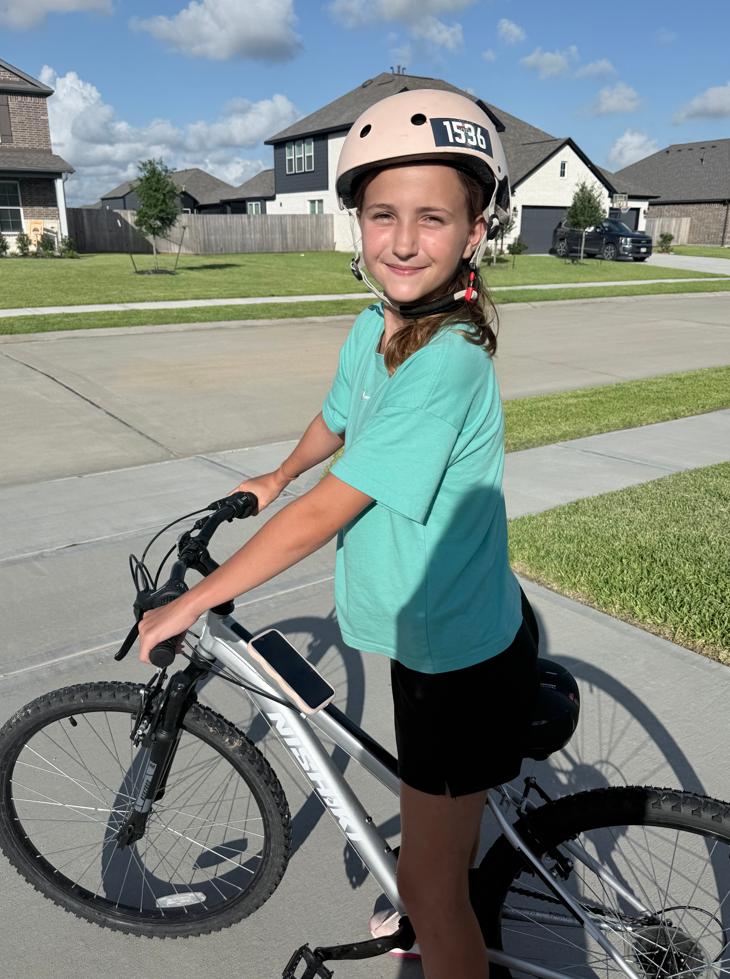
Halle Neely, 11, pictured riding her bike with a helmet after a scooter injury left her with an epidural hematoma that required brain surgery. (Photo by Heather Neely)
“It’s truly incredible,” Heather said. “If you saw her right now you would have no idea that she even went through that traumatic event.”
As she enjoys her summer break and prepares to enter sixth grade, Halle has cautiously gotten back on her electric scooter—but always with a helmet, which she now encourages all her friends to wear.
“I was a little scared to ride the scooter before my injury, and then I went on it and had tons of fun. And I was like, ‘Okay, there’s no need to be nervous, because nothing bad can happen,’” Halle said.
Now, helmets are nonnegotiable.
“I found out the hard way,” Halle said.
To learn more about how kids can stay safe on electric scooters, visit UTHealth Houston’s Ask the Expert series.


